Ignite the Process of Learning
These provocations are designed to spark curiosity and invite students into mathematics without prescribing a specific outcome. Rather than being told what to do, students notice, wonder, and begin asking their own questions, naturally uncovering the need for mathematical thinking and application. Guiding questions provide just enough structure for teachers to align with curriculum expectations while preserving student autonomy. Many of these tasks span across year levels, allowing all learners to engage in the same conceptual context with different levels of depth and complexity. As students explore, essential skills emerge through meaningful inquiry (and are subsequently taught explicitly by teachers) positioning mathematics as something they actively use to make sense of the world.

Mind the Gap...

AN INQUIRY INTO SCALING AND ITS CONNECTEDNESS TO PLACE VALUE

Facilitating Questions
- What’s wrong with this image?
- What math can we use to fix it?
- How would you fix the image?
- Should we shrink the car or enlarge the tower?
- What scale would make everything consistent?
Curriculum alignment
- 4.OA.A.1–2: Multiplicative comparison (“how many times bigger?”)
- 4.NBT.A.1: Place value understanding (powers of 10)
- 5.NBT.A.2: Patterns when multiplying/dividing by 10
- 6.RP.A.1–3: Ratios and proportional relationships
- 7.RP.A.2: Proportional reasoning and unit rates

An inquiry into how the same amount of space can be organized in different ways
Facilitating Questions
- What dimensions might make a building more suitable for different purposes?
- In the case of different natural disasters, which building would you rather be in and why?
- How can two buildings look very different but still take up the same amount of space?
- What might change inside a building if we stretch it taller or make it wider?
- How could we determine if these buildings actually have the same amount of space inside?
Curriculum Alignment
- 5.MD.C.3–5: Recognize volume as an attribute of solid figures and relate volume to multiplication and addition
- 5.NBT.A.2: Patterns when multiplying/dividing by powers of 10 (scaling dimensions)
- 6.RP.A.1–3: Ratios and relationships between dimensions (height, width, depth)
- 6.G.A.2: Find volume of right rectangular prisms with fractional edge lengths
- 7.G.B.6: Solve real-world problems involving volume of three-dimensional figures
An inquiry into how the same journey can be described in different ways, and what we need to make sense of it
Facilitating Questions
- If you were actually taking this trip, what would you need to figure out before you go?
- What might be confusing or different about traveling between these places?
- How could two people describe the same trip in completely different ways?
- What would you do if the information you needed was in a unit you don’t understand?
- How could we make all of this information easier to understand and compare?
Curriculum Alignment
- 4.MD.A.1–2: Solve problems involving measurement and conversions of units
- 5.MD.A.1: Convert among different-sized standard measurement units
- 5.NBT.A.2: Patterns when multiplying/dividing by powers of 10 (metric system connections)
- 6.RP.A.1–3: Ratios and unit rates (conversion as multiplicative reasoning)
- 7.RP.A.2: Analyze proportional relationships and solve problems involving proportions

An inquiry into fair and unfair conclusions Facilitating Questions
- What do you notice about the comments shown compared to the total number of comments?
- Can we make a fair judgment about the video based on only these comments? Why or why not?
- How might our opinion change if we saw more of the 5,000 comments?
- What would be a “good” or “enough” sample to understand what people really think?
- How could we collect or choose comments in a way that better represents all 5,000?
Curriculum Alignment
- 6.SP.A.1–2: Develop understanding of statistical questions and variability
- 6.SP.B.4–5: Summarize and describe distributions (thinking about overall trends vs small samples)
- 7.SP.A.1–2: Understand that statistics can be used to gain information about a population by examining a sample; compare random vs biased samples
- 7.SP.B.3–4: Draw informal inferences about populations from samples
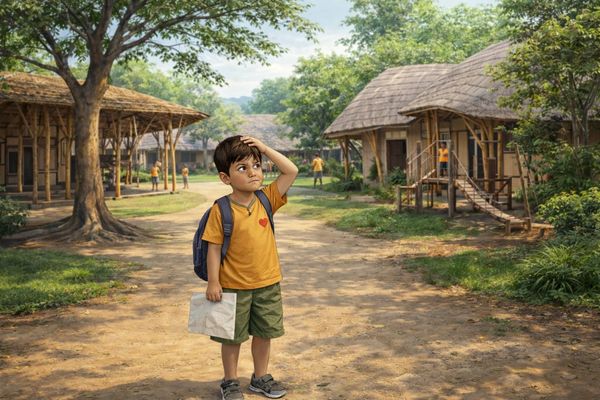
Prompt for inquiry: If a new student joined our school, how could we help them find their way around?
Facilitating Questions
- What would a new student need to know to get from one place to another in our school?
- How could we describe where things are so someone else can understand?
- What makes directions clear or confusing?
- How could we represent our school so others can find their way without us?
- What information would be important to include on a map?
Curriculum Alignment
- 1.MD.A.1–2: Measure lengths using nonstandard and standard units
- 2.MD.A.1–4: Measure and estimate lengths; represent whole-number lengths on a number line
- 2.MD.D.9–10: Represent and interpret data (e.g., distances, routes)
- 3.MD.B.4: Generate and interpret measurement data
- K.G.A.1–2: Describe positions of objects (above, below, next to, etc.)
- 1.G.A.1: Distinguish defining attributes of shapes (used in map features)

An inquiry into how coordinates can be used to represent, communicate, and interpret stories about place
Facilitating Questions
- What story might these points and locations be telling?
- How could coordinates help us describe where something is happening?
- What patterns or relationships do you notice between the points?
- How might changing a coordinate change the story being told?
- How could we use coordinates to communicate something clearly to someone else?
- How could we use the grid to figure out actual distances or sizes in the real world?
Curriculum Alignment
- 5.G.A.1–2: Use a coordinate plane to locate and represent points
- 5.NBT.A.2: Patterns in place value (understanding coordinate structure)
- 6.NS.C.6: Understand rational numbers as points on the coordinate plane (including negatives)
- 6.RP.A.3: Use ratios and reasoning to interpret relationships between quantities (distance, scale on grid)

An inquiry into the connectedness between fractions and farming.
Facilitating Questions
- How might this farm be divided into parts, and how could we describe those parts?
- If different crops need different amounts of water, how could we figure out how much water the whole farm needs?
- What happens when we combine or compare different parts of the farm?
- How could we represent and simplify the portions of land used for each crop?
- How might changing the size of one section affect the rest of the farm?
Curriculum Alignment
- 3.NF.A.1–3: Understand fractions as parts of a whole
- 4.NF.A.1–2: Equivalent fractions and simplifying
- 4.NF.B.3: Add and subtract fractions with like denominators
- 5.NF.B.4–6: Multiply fractions (e.g., water per section × number of sections)
- 5.NF.A.1–2: Add and subtract fractions with unlike denominators

An inquiry into how angles, area, and shape influence the design of your dream space
Facilitating Questions
- How do different shapes change how a space looks and feels?
- What role do angles play in how structures are built and connected?
- How might the size and area of different parts affect how the space can be used?
- What happens when we combine or rearrange shapes to create a new design?
- How could we design a space that is both functional and visually interesting?
Curriculum Alignment
- 3.G.A.1–2: Understand and classify shapes; partition shapes into equal areas
- 4.G.A.1–3: Draw and identify lines and angles; classify shapes by properties
- 4.MD.C.5–7: Understand and measure angles
- 5.MD.C.3–5: Relate volume to multiplication (space within 3D design)
- 6.G.A.1: Find area of polygons by composing and decomposing shapes
- 6.G.A.2–4: Apply area, surface area, and volume to real-world contexts

An inquiry into.. how the way we move shapes affect what is possible?
Facilitating Questions
- Where and how will you move and place the next two shapes?
- What are you paying attention to as you decide where each shape goes?
- How can this shape move or change position without changing its form?
- What changes when you turn a shape, and what stays the same?
- Would being able to flip shapes make the game easier or more difficult? Why?
- How do different ways of moving shapes influence the decisions you make?
Curriculum Alignment
- 5.G.A.1–2: Understand how shapes move (translation on grids)
- 5.G.B.3–4: Classify shapes; orientation does not change attributes
- 6.G.A.1: Compose and decompose shapes to solve problems
- 8.G.A.1–3: Understand and apply geometric transformations (translations, rotations, reflections)
An inquiry into what makes a slide safe
Facilitating Questions
- What do you notice about these slides?
- What’s the same? What’s different?
- Which slide would you choose? Why?
- Which slide feels the safest? What makes you think that?
- What is different about how steep each slide is?
- How could we describe or measure what makes a slide safe?
Curriculum Alignment
- 2.MD.A.1–4: Measure and compare lengths; determine how much longer one object is than another
2.G.A.1: Recognise and draw shapes with specific attributes (triangles begin to emerge)
3.MD.B.4: Generate and represent measurement data
4.MD.A.2: Solve problems involving measurement and comparison of lengths
5.G.A.1: Represent real-world situations using coordinate systems
6.G.A.1: Find area of triangles; connect geometric structure to context
7.RP.A.2: Recognise and represent proportional relationships (steepness as a relationship between height and length)